

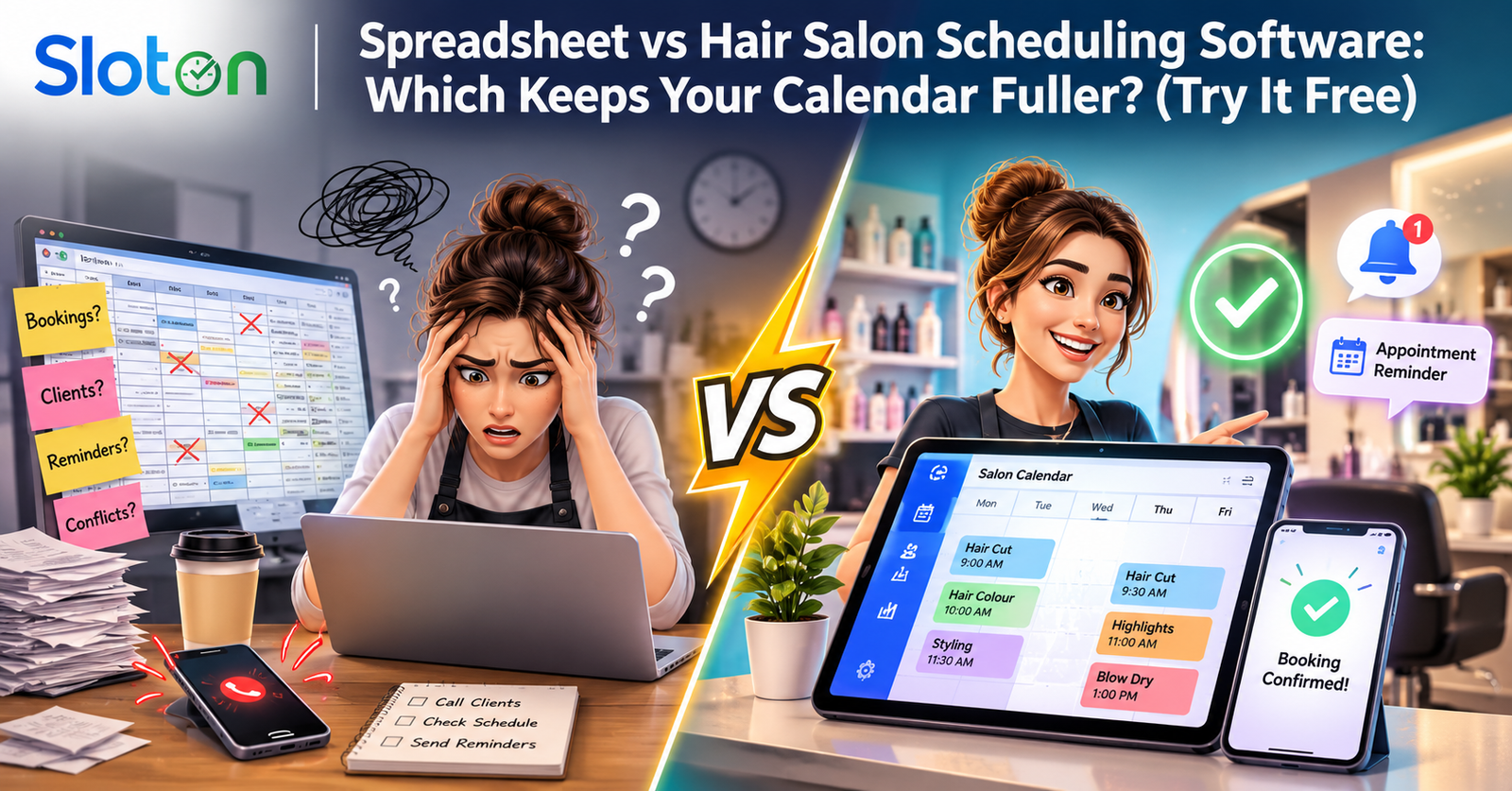
It is 9:40 p.m. You are on the couch, phone in one hand, a half-finished spreadsheet open on the other screen. A client just messaged to move her colour appointment. Another asked if you have anything Thursday. You think you have a gap at 2 p.m., but you are not sure whether that cell is blank or just not updated yet.
If that feels familiar, you are in good company. A spreadsheet is where almost every salon begins, and for a while it works. But there comes a point where your calendar starts running you instead of the other way around.
This guide puts the spreadsheet head to head with hair salon scheduling software, so you can see honestly which one keeps your chairs fuller and your evenings free.
Why Salons Start With Spreadsheets (and Why It Makes Sense)
Let’s give the humble spreadsheet some credit. It is free, familiar and flexible. You can set it up in an afternoon, colour-code your stylists, and nobody needs training.
For a brand new solo stylist with a handful of regulars, that can be perfectly fine.
The trouble is that a spreadsheet is a record, not a system. It stores information, but it does not do anything with it. It cannot remind a client, take a deposit, stop a double booking or fill a cancelled slot. Every one of those jobs lands back on you.
Where Spreadsheets Start to Cost You Clients
Double bookings and missed updates
Two people can book the same slot because one message came through Instagram and another by text, and nobody updated the sheet in between. A double booking is not just awkward. It can cost you a client for good.
No-shows with no safety net
A spreadsheet will never nudge a client the day before. If someone forgets, the chair sits empty and the revenue disappears with them.
Booking only happens when you are awake
Clients now expect to book on their own time, often late in the evening. If your only booking method is “message me and I will check,” some of them simply book with the salon that lets them do it instantly.
Messy client history
Which colour formula did Maya use last time? What does Jordan always book? In a spreadsheet, that information is scattered across tabs, notes and your memory. A client who has to repeat herself every visit feels less looked after.
Time lost on admin
Replying to messages, rearranging columns, checking who paid, chasing deposits. None of it is hair, and all of it takes time you could spend with clients or on a break.
What Hair Salon Scheduling Software Actually Does
Think of it as the receptionist that never sleeps. Good scheduling software gives you:
- Online booking so clients pick a service, stylist and time themselves, any hour of the day
- Automatic reminders that cut down on forgotten appointments
- Staff scheduling that keeps every stylist’s calendar clear and conflict-free
- Client profiles with visit history and notes in one place
- Payments and deposits to protect your time on bigger services
- Analytics that show your busiest days, top services and gaps
Everything lives in one calendar that updates in real time, so the “is that slot free?” guessing game ends.
Spreadsheet vs Scheduling Software: Side by Side
| What matters | Spreadsheet | Scheduling software |
| Setup cost | Free | Many options start free |
| Online booking 24/7 | No | Yes |
| Automatic reminders | No | Yes |
| Prevents double bookings | No | Yes |
| Client history | Manual | Built in |
| Deposits and payments | Manual | Built in |
| Reports and insights | Manual | Built in |
| Time spent on admin | High | Low |
The spreadsheet wins on one thing only: it costs nothing to start. Everything else tilts toward software.
Which One Keeps Your Calendar Fuller?
Honest answer: the one that fills gaps and prevents leaks.
A fuller calendar comes from three things: more bookings coming in, fewer appointments falling out, and fewer empty gaps between clients.
Software helps with all three. Online booking captures clients at the moment they decide to book. Reminders reduce no-shows. A clear, live calendar makes it easier to offer a cancelled slot to someone else quickly.
A spreadsheet can only do those things if you do them manually, every single time.
The Hidden Cost of “Free”
Free is great until you count your time. If you spend even a few hours each week on messages, reminders and calendar fixes, that is time you are not earning.
Here is a simple exercise. Write down how many hours a week you spend on scheduling admin. Multiply by what an hour of your time is worth. That number is the real price of your “free” spreadsheet.
Many owners are surprised when they see it written down.
Running Payments Too? Read Our POS Guide
Scheduling is only half of the front-desk story. Once a client has booked and had their service, you also need a quick, tidy way to take payment. If you are curious how booking and checkout can work together, our guide on a POS system for small business explains how faster checkouts and a clear sales record help your business too.
Is It Hard to Switch From a Spreadsheet?
This is the number one worry, and it is usually bigger in the mind than in real life.
Most salons make the move in a few simple steps:
- Add your services and prices (the spreadsheet you already have makes this quick).
- Add your stylists and their working hours.
- Import or add your regular clients.
- Share your booking link on Instagram, Facebook, Google and your website.
- Switch on reminders and let the system get to work.
You do not need to switch everything on day one. Many owners run both for a week or two, then retire the spreadsheet once they trust the new calendar.
Built for Hair and Beauty, Not Just Any Business
Salons have their own rhythm. Services have different lengths, stylists have different specialities, and clients often rebook the same time every few weeks. Software built for appointment-based businesses understands that.
See how Sloton supports salons and beauty businesses on our beauty and wellness page, or explore the full range of industries we support if you also run a nail bar, spa or clinic alongside your salon.
A Quick Reality Check on the Business Side
Running a salon often means running a small business on your own. According to the U.S. Bureau of Labor Statistics, a large share of hairdressers, hairstylists and cosmetologists are self-employed. That means the person cutting hair is usually also the one answering messages, doing the books and chasing the diary. Tools that give some of that time back are not a luxury. They are how the business grows without burning you out.
What Does It Cost to Upgrade?
Good news: you do not need a big budget to try it. Sloton offers plans designed to start free, with no setup fee, so you can test the calendar with real clients before you commit to anything. When your salon grows, you can compare options on our pricing page and choose what fits.
So, Spreadsheet or Software?
Here is a simple way to decide.
Stick with a spreadsheet if you are a solo stylist with very few bookings, you rarely get no-shows, and managing messages is not a problem.
Move to scheduling software if you have more than one stylist, you get regular rescheduling, you have been burned by no-shows or double bookings, or you simply want your evenings back.
For most growing salons, the switch pays for itself quickly in time saved and appointments kept.
Ready to Fill Your Calendar?
Stop guessing which cell is free. Let your calendar do the work while you do what you love.
Start free with Sloton today and set up your salon calendar in minutes. No setup fee, no pressure, just a fuller diary.